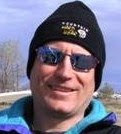
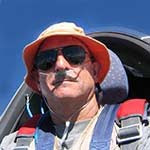
Oh what a great flight, for Alby and for myself: Alby flew over the ocean and I did an unusual and difficult flight. It happened on the Saturday that was Octoberfest in Williams, but the weather that day was not the most desirable for the event: There was a strong north-northeast wind that had discouraged many pilots. At the morning briefings only half a dozen of pilots were present. The forecast was similar to yesterday’s, with strong winds from the north all over California. Yesterday the forecast was for 25 to 30 knots wind, some clouds with high bases (10,000’ to 11,000’) near the coast, a critical height of 7,000’ and a top height of 9,000’. That was a very unexpected forecast: why, with a north wind, would the lift go that high?
But in the afternoon from my office I could see the far away clouds so I believed the forecast was accurate. For the past few weeks I had focused on taking Alby to Byron and looking at the long way out I would have to use in Friday and realizing it would take me close to the coast at high altitude, the thought sprung out that in a day like this I could have taken Alby to the ocean. One of the things that I really wanted to begin Alby’s voyage was to take him over the Pacific waters, and eventually it will have to be done over the Atlantic waters too. So originally the plan was to take Alby to Hollister, much closer to the ocean than we are in Williams, and there Ramy would take care of doing the flight or having somebody do it. So I had the dismay feeling that I missed a good, albeit unexpected, occasion to do a very fitting flight, innovative and especially fitting to Alby (it is not easy at all to reach the ocean even from Hollister, although it is nearer).
On Friday evening the forecast for Saturday was similar but not as favorable: yes there was a band of high lift close to the coast, but lower than yesterday reaching 8,000’, and no clouds. There was a band of poorer heights (6,000’) in the interior, that had to be crossed. Thermal strength was about 5 knots versus yesterday’s 6. And the winds were still strong, although a little less at 25 knots. Still heavy with the disillusion of having missed yesterday’s occasion, I commit myself to try the flight anyway; you never know what happens until you are there.
I start at 11:48 after Luke who evidently took the first lift he found and missed it, and was coming back to landing. We find a couple of lifting areas on the way but I resist until we are downwind of the ridge that goes to the Tree Farm. From release altitude at 6,000’ we circle to about 9,000’ being drifted downwind about 3 miles by a 21 knots wind. One mile away I could see Luke, who meanwhile had taken another tow, just going straight upwind and climbing. The lift is very smooth although weak at 2 knots and we both think it is wave, although it is unusual to climb going upwind for such a long stretch rather than across the wind. However, it is parallel to the lesser ranges bordering the San Joaquin Valley.
Reaching 9,000’ I move along the ridge in the direction of the Tree Farm, but the lift is not there. Sink begins. I move swiftly towards the backside of Goat Mountain, but I find no wave there. We are losing altitude rapidly and we turn back promptly. Unrelenting sink forces us back towards the area where I found lift before, which we reach at 4,500’, while Luke says he is at 12,000’ above us now.
Down here I sense some lift and scratch around for 15 minutes before finding one knot, than two. But it becomes better and better until we are going up with 5 knots in the averager and for a couple of minutes with 6 knots. At 13,000’ the lift ends and I begin to move west. The evening before I had studied different scenarios, like going to Ukiah or things like that but in the actual situation I regress to familiar routes, directing towards Mt. Saint Helena to look for wave there. I have the McCready at 1 knot and my speed over the ground is pretty swift. But it does not work as expected. I am finding continued sink. I find a bit of lift in front of Mt. Konocti but not in the back of it, same for Mt. Cobb. At Mt. St Helena too, there is some poor lift upwind, but sink downwind. Over the middle of the Calistoga Valley I find a little thermal which takes us back to 8,500’, and so encouraged I continue west.
I am in unknown territory now. In the morning I had placed in the GPS the airport of Healdsburg, and that is my only reference around here. I am still high at almost 7,000’ and still checking my glide to Healdsburg when I stop in a thermal and with big surprise I find out I am above a majestic airport, with two runways angled in a “V” shape. It is the Sonoma County airport. That’s a good new. Now the coast is about 20 miles away and really tempting. I force myself to still look for areas of possible lift, and I find one that takes us slowly to 7,500’. This should be reassuring in most circumstances but still I do not trust the incomprehensible features of the day. I have been twice today in strong unrelenting sink without finding a way out until the sink stopped without apparent reasons.
I do the last 8 miles to the coast still apprehensive about the altitude, and I go over the ocean for only a half a mile or so. The ocean is a beautiful sight, with the strong winds producing foaming waves that run parallel to the coast. I notice how the wind on the ocean is converging towards the coast while the winds on the land are going towards the ocean, albeit at a shallow angle. There might possibly be some lift generated somewhere where the winds meet but I do not find trace of it. As it so happens, we are north of Bodega Bay and just south of the Russian River, and I recognize the places where I visited with my wife time ago.
I go back to the last thermal and nearby I find another one that takes us back to 7,000’. Of course the next step is to look for the Sonoma airport where I found that nice thermal before and I find it again and climb to 8,ooo’. This is encouraging. I would be happy landing here but I can try to go to Crazy Creek. We direct more or less upwind. To the north of Mt. Saint Helena I find enough lift to get in glide to Crazy Creek, which I reach shortly thereafter. Of course the going is slow with such a headwind, but near the coast had been benign, about 12 knots, and I even found 8 knots. Just on top of the Crazy Creek airstrip I find good wide lift that takes us to 8,000’ where I read 16 knots wind. Notwithstanding the wind I have Charters just exactly in glide. Let’s see what happens now.
I direct more or less towards the Three Sisters that I can recognize from here. Immediately I find some sink, which once again does not stop but continues unabated. I have –2, -3 in the “Netto” which translates to –4, -5 actual sink. We are losing altitude desperately and quickly. Charters is no more in glide but I am proceeding just waiting for some lift to appear, with an eye on my glide to Crazy Creek. All of a sudden I realize that if I go back I have to pass trough the same sink I just encountered. I check the computer: I have 1,500’ above glide for Crazy Creek, and I turn back immediately.
Of course I am taking a different route, more to the west and I find that the sink is milder here. I am going towards a knoll that in the past has been good producer of thermals. It works, and I go up to 7300’ before the lift peters out. While climbing I had decided to go straight upwind, because this is what seems to work today. I take aim at the knoll (we have drifted 4 miles) look far away to a reference point and find us directed to a point west of the Walker Ridge. By coincidence, it looks we are directing straight to the place where we have found the wave at the beginning of the flight. I take it as a good omen and go, thinking that if I cannot make it now, I will land back in Crazy Creek and get a retrieve.
But it works great. I find much-reduced sink and some bumps of lift. I move the McCready to find the best speed to fly and find out that if I set it at 1,5 knots; I can reach Charters at the highest possible altitude. I am 1000’ below glide for Charters but in glide for Crazy Creek so I continue until, I find lift! Yes it takes us back 2 miles but it takes us from 5,500’ to 7,600’ and now I have more than a thousand feet above glide for Williams! I feel totally relieved. Without this last thermal, the flight would probably end at Crazy Creek.
On the long final glide I also take full realization of the clarity of the atmosphere today. At all times during the flight I could see far and clear, from Williams to the coastline. The computer makes us point the glider nose about 30 degrees to the north of the direction for Williams, because now the wind has come back to about 20 knots from my left.
The last episode of the retreat to Crazy Creek, the milder sink on a different route, and similar findings coming back from the coast makes me realize that today we did not have wave at all. When you go cross-country in wave, you find alternate bands of lift and sink oriented across the wind. Today, the bands were oriented along the wind. That is why at the Farm Tree we stayed in the lift going directly upwind. It may happen that we have large bands of lift in wave days, but not this large; and we have sink before and after the lift, which we did not have today. The lift at the Farm Tree was so smooth that it really resembled wave, but it was not: It was a convergence line. The whole day we passed through sinking and lifting convergence lines and I never realized it until now. The main reason why we thought it was wave is because the lift was so smooth, smooth like a wave.
I have seen this phenomenon in Texas in some days: clouds form in the early morning with bases of less than 1,000’ and organize in parallel cylindrical rolls oriented with the wind, spaced 1 mile or so. The rolls extend to the visible horizon, you can see the clouds moving downwind and you can see the internal movement of the roll, lifting in the middle and cascading on both sides. The formation continues until mid morning increasing rapidly in altitude until the pattern disappears in the general turbulence of the summer day convection.
On the ground I feel triumphant, elated like at my first flights many years ago: Alby has now made his flight over the Ocean, his Voyage has started. I do not think anybody has ever done a flight like this from Williams: normally it is impossible to do it, and on the rare day it is possible to do it, nobody does it because there is no special reason to do it. But we (Alby and I) had a reason and we did it, no matter how unlikely it was at the beginning of the day. At dinner one of the presents tells me that a curious thing happened about ten years ago. An albatross was found, apparently lost, just there at Bodega Bay. It was named “The Lost Albatross”, and it made the news for one week, after which it took flight and disappeared.
What a parallel with Alby’s story and what a fitting coincidence. Sometimes reality is more fantastic than fantasy.
View flight on OLC
Alby's Progress
Map Legend
___ Successful Legs
___ Attempts
___ Proposed legs
___ Trip "by glider" to NY
Click, hold and move the mouse to move the map.
Point hand's finger, click on markers to read airport information.
Point hand's finger, click on path legs to read flight information.
Click on Sat (bottom left) to see aerial picture, enlarge to see airport.
Click on "View Larger Map" above to see full screen .
___ Attempts
___ Proposed legs
___ Trip "by glider" to NY
Click, hold and move the mouse to move the map.
Point hand's finger, click on markers to read airport information.
Point hand's finger, click on path legs to read flight information.
Click on Sat (bottom left) to see aerial picture, enlarge to see airport.
Click on "View Larger Map" above to see full screen .
latest news
11/10/2017 - Sarah Arnold and Karl Striedieck fly the ridge, take one thermal to climb to just under cloud base and fly straight with no turns to Harris Hill, NY. Pins no. 32 and 33. Trafford Doherty, Director of the National Soaring Museum takes Alby in his care. Alby has now completed his Voyage.
8/5/2017 – Shane Neitzey took Alby from Front Royal to Eagle Field with a spectacular ridge flight – plus some thermals. See the flight on the OLC. With his flight Shane gained Pin No. 31.
Alby is now in the capable hands of Karl Striedieck who will make the final leg to Elmira, NY venue of the National Soaring Museum. This last leg is tricky but Karl is confident he can make it, with the best period for the attempt in October.
8/4/2017 – Dave Reilly flew Alby from Culpeper to Front Royal, completing his leg and earning Pin No.30.
7/16/2017 – Alby is at Culpeper airport, taken there by Dave Reilly who made it almost to Front Royal, but was 20 miles short when he decided to go back a little and land safely at Culpeper. He wants to try again soon.
6/3/2017 – Mamad Takallu flies his ASW-27 from Garner to Merlin, earning Pin no. 29 with a powerful straightforward flight.
7/17/2016 – Eric Lambert after almost one year abandons dreams of making a pure glider flights, starts the engine and motor all the way from Currituck to near Garner.
9/17/2015 - Eric Lambert flies Alby from First Flight to Currituck using the engine of his motorized Grob.
9/14/2015 - Alby arrives at First Flight, Kitty Hawk, NC!
Heartfelt congratulations to Alby pilot Eric Lambert, who found reliable lift on a blue day to get Alby safely to Kitty Hawk, for a well-deserved rest. Eric's notes on the flight are found in more detail below.
Briefly, he said, "I will return to First Flight in the morning and plan to meet with Karen Warlitner, the Executive Director of the First Flight Foundation, for a photo-op. We would like to have a photo of Alby next to the Wright Flyer. On Thursday and through the weekend, we hope to take advantage of this spell of good weather to fly Alby north."
8/31/2015 - Alby flew Sunday from Chesapeake, VA to Currituck , NC with Albypilot Eric Lambert in his motorized Grob 103.
Eric said that he found clouds to 5,000’ and lift up to 4 knots. He got low (1,700’) at the Academia facility (U.S. Training Center) but got back up to 4,000’ and then to Currituck. He said it was not difficult – sure I believe it, when the conditions are good! The flight of 25 miles required only two thermals, but it was one of the very few days that there were clouds and workable lift and no adverse winds. Clouds and lift disappeared soon after the landing.
Eric wants to spend four days of the long Labor Day weekend trying to fly with Alby the 33 miles from Currituck to First Flight Airport, a place that is so historically important for all aviators. Not an easy thing to do since near the coast the weather is not favorable to soaring in general, and in this case in particular the glider has to fly for several miles directly above water.
TALES OF THE FLIGHTS

Alby in the News
The flight of the Albatross across our Country caught the attention and the fantasy of a newsmaker, Adam Breen, who published a well written and inspired article in Hollister's "The Pinnacle" newspaper: www.pinnaclenews.com/news/contentview.asp?c=255106
The flight of the Albatross across our Country caught the attention and the fantasy of a newsmaker, Adam Breen, who published a well written and inspired article in Hollister's "The Pinnacle" newspaper: www.pinnaclenews.com/news/contentview.asp?c=255106
Alby's Story
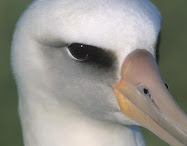
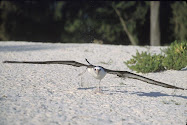
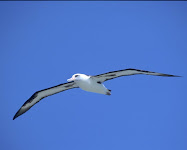
Alby is a Laysan Albatross. He was born and raised in the Midway Islands, not far from the very same Laysan Island that gives names to all the individuals of his species. His parents fed him for six months. They alternated trips of one or two weeks, during which one of them was feeding and the other was protecting Alby and the nest. The long intervals were necessary because often the food was very far away, up to 400 or 600 miles away. They fed him until he became as big as them, and then suddenly deserted him. They did that because they instinctively knew that he was developed enough to take care of himself from then on. And they could not spend all their energies in raising a chick. Although they can live 40 to 60 years, they can only raise a chick every couple of years.
The young albatross did not know all the tricks of life at sea, and the first year he had difficulties at times. One half of the fledglings do not make it through the first season, but Alby did, and everything was much easier after that. He went out on the open ocean and did not come back for years, not touching land at all, living off the bounty of the ocean, sleeping on it, learning to travel using the wind forcing the air up against the moving ridges formed by the waves.
Alby came back to his native island when he was three years old, because his biological clock was giving him the urge to look for a mate. His tentative dances with prospective mates were as clumsy as those of the other young albatrosses around him. Naturally nothing happened, but he experienced and practiced the ways of the elders.
He is 4 years old now. He has wandered the ocean all this time. He has gone through the vast expanses of water finding food, freedom, and safety. He has gone to the north Pacific and flown around the Aleutian Islands and the Gulf of Alaska and the fiords of British Columbia. Next year he will try again to go back to his birthplace to search for a mate, and probably will find one.
Albatrosses are at home in the open ocean, keeping at least 30 miles offshore. But Alby is different. He is curious about the land, just as curious as a young soul can be. In his voyages near the northern seashores he watched eagles fishing for salmons. That was not his preferred food, but he looked with interest at this different method of fishing. He communicated with the eagles, answering their whistles with his screeches.
He is fascinated by the land, but unable to penetrate it - he is used to mastering the wind over the waves, and the different way of flying inland is unfamiliar to him. He asked Eagle about the extent of the land, and Eagle said that there is land up to the summit of those far away mountains to the east, and more.
One day he met Pelican, and while they were floating and chatting over the gentle waves of a mild afternoon he learned that Pelican had actually been inland while flying with his flock. He had flown across the fertile valley of California, and over the magnificent mountains of the Sierra Nevada and farther more to the northeast. Alby learned that inside the land, beyond those far away mountains, there is a great lake, and peaks with snow, and forests and valleys, and towns and people.
Pelican described the beauty of the land, which is called America, according to what he heard when people talked about it. Being a sociable character, when he was inside the land Pelican also had contacted other big birds and knew a good deal about what lay farther inside that large country.
Pelican learned from the other birds that there are large deserts and arid mountains in the interior highlands. There are very few people in those deserts, few roads, few machines. Nature is mostly untouched by man there, with many animals running free. The air is not disturbed by artificial smells and mechanical noises. It takes many days of overflying this natural environment before reaching the majestic mountains of the Continental Divide. Here the land is green again with large forests. Snow may remain up to late summer, the rocks are harsh and austere.
From there one can overfly the vast farmlands that gradually decrease in elevation until they make room for the mighty rivers that cut the America land in two. Pelican had also contacted seagulls that told him about more land to cross going east, with plenty of houses and towns and people. There are cities sporting very high buildings that tower up toward the sky. There are rivers and lakes where an aquatic bird can feed. He heard tales from vultures and hawks that there is another long range of lower mountains and beyond that, couple of days away as the crow flies, there is ocean again.
Alby would like to go inland, see the beauty of the country, but he is not fit to go there. He does not know how to master the thermals the way eagles, pelicans and other birds with big wings travel there. He is made for the ocean.
Still he would like to go and try to cross this enormous island that he cannot cross, and get to the sea on the other side.
One day he flies along the shore, and sees some very big wings flying along the cliffs of the big town called San Francisco, as he understands people call this place.
Approaching those big wings, he realizes that there are people hanging on them. He discovers then that people cannot fly on their own, but have created artificial wings that support them. He knows what they are doing; he knows how to fly along the cliffs. He knows that, ‘cause such was the very kind of flight he took when he left his nest for the first time.
Soon those cliffs become a favorite place for Alby. He flies there often and so close to the flying people that learns many of the words they speak. He listens and learns that there are even bigger and faster flying machines with long wings for the people that like to fly like birds, which are called gliders or sailplanes. And there are flying crafts with propelling engines, capable of transporting many people at high speed. He understands now what are those enormously high flying machines that cross the ocean, so high that he barely can hear their sound through the whistle of the wind.
The flying people are impressed by the unusual behavior of this albatross, which so often flies with them instead of flying far away in the ocean like others members of the same species. They imagine that Alby wants to travel ashore, but does not trust doing it by himself.
The soaring people offer to take Alby inland, and to show him the beauty of the countryside. They offer to take him aboard their flying machines and let him cross this big island in silent winged crafts, no noises, no vibrations, no offending gas smells.
Alby accepts the invitation. He wants to see the mountains, the valleys, the lakes, the deserts and the forests, and the towns and the towers, and the roads and the bridges and the rivers of this beautiful land called America. He realizes that it is not possible for him to travel here alone, without the help of the flying people.
So the soaring people take Alby in their silent aircrafts across that vast territory. They understand. Because they themselves share the curiosity, the need for adventure, the thirst for knowledge of that young spirit. They share the independence that flying gives, the endless autonomous decisions that need to be taken in this constantly moving environment. They know the far-reaching view that this privileged position allows. But most of all, they share the elation of infinite freedom by being immersed in the sky, floating, suspended in the brilliance of this transparent ocean. Those are the reasons why they aimed for the skies, and now they cannot live any more without the magic of flight.
They take Alby with them, in the togetherness that unites all aviators. Alby’s great voyage has just begun.
Rules
ORGANIZATION OF THE VOYAGE
This website is recording the flights of Alby, his whereabouts and his flight log. The webmaster of the site is the Albymaster. All news and inquiries about Alby will be handled by this site.
Alby wishes to soar across America. He wishes to see it all, from the Pacific Ocean to the Atlantic, and then resume his wandering life across the seas.
Alby flies only in aircraft that use the energy contained in the atmosphere as a means for traveling. Motorgliders can use their engine only for taking off.
A proposal to fly with Alby shall be sent to the Albymaster. A proposal shall include a pre-declaration of the proposed flight.
Preference will be given, in order, to the site that is closer to Alby’s current location, to the first proponent in order of time, to soaring clubs or associations, to groups of pilots, or to an individual pilot. This means, for example, that an individual pilot has to wait for the soaring club to fail its attempt, before making its own attempt.
A club or pilot that has proposed to fly with Alby and has been accepted by the Albymaster, will be called the Albypilot. When a proposal is accepted, the flight should be made before the end of the next Friday.
If no other Albypilots have made the flight on their assigned week, the hosting club or pilot will have the right to make the flight before the end of the next Friday. If the host did not propose or is not able to make the flight, the next Albypilot shall make the flight before the end of the next Friday. And so on.
RULES FOR THE FLIGHT
Gliders can be towed to an altitude not exceeding 3,000’above take-off. Motorgliders will shut off their engine before that altitude is reached. The release or engine shut-off point shall be west of the take off field.
Each landing point will be to the east of the take-off point. If difficulties arise, an occasional back leg may happen, when accepted by the Albymaster.
The flight should end in a soaring site, or a place from where a glider can be towed out. If the flight does not end in the pre-declared location, the Albypilot or a pilot of the same club still have to the end of the next Friday to try and complete the flight as declared. If the pre-declared location still is not reached, Alby must be taken back where it started (not necessarily by flying).
Both the current host of Alby and the new host shall communicate the outcome of the flight to the Albymaster.
If the flight cannot be made before the end of the next Friday by the first Albypilot, it is the responsibility of the first Albypilot to give notice of the inability to make the flight, with timely courtesy, to the Albymaster, to the host, and to the second proponent in line.
The Albypilot who flies with Alby is responsible for keeping good care of him. When the Albypilot represents a soaring club or association, the representative of the club or association will be responsible for the well being of Alby.
The above rules may be superseded by the Albymaster when atypical circumstances arise.
Order of Preferences:
1 - The club that is closer to Alby’s current location
2 - The club that proposes first in order of time
3 - Clubs, soaring associations, soaring centers
4 - Group of pilots
5 - Individual pilots
ACCESSORY RULES
When start altitude, release to the west, landing to the east are difficult because of special local conditions, an exception may be requested to the Albymaster.
When an Albypilot cannot make the flight in the week he/she has been assigned, another Albypilot can make the flight provided he/she has been accepted by the Albymaster.
LOGBOOK, LAPEL PINS, SPOT DEVICE, GPS TRACE
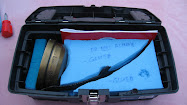
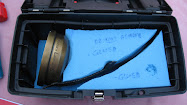
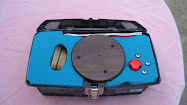
LOGBOOK - Alby travels with a logbook. The Albypilot will fill out the log entry and sign it. The flight data will be e-mailed to the Albymaster and an entry will be placed in the website logbook. A description of the flight and pictures may also be sent along with the flight data, to be posted in the website. Enter all flights, successfull or not.
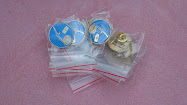
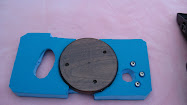
LAPEL PINS - The Alby case contains lapel pins. The pilot(s) successfully accomplishing a flight will get one pin each. The lapel pins are numbered. Check in the log book for the last pin number and take the subsequently numbered pin(s). If the flight is not successfull, place a bar in the last column (Pin No.). Please guard carefully the pins, we do not want them to misteriously disappear.
SPOT DEVICE - The SPOT device is to be placed in the glider in a place where there is sufficient visual contact with the outside (inside a shirt pocket is OK). It is to be used during the flight and placed in Alby's case when not flying. Instructions for use are in the case.
GPS TRACE - Pilots are encouraged to send their GPS log no matter how successfull the flight, as it will be posted in the map (flying with Alby is already a great success, to be recorded and displayed). Alternatively, it can be downloaded to OLC.
DISCLAIMER
Pilots who participate in Alby’s voyage acknowledge that it is a voluntary effort, and that the timing, route selection, weather decisions, and all other aspects of the flight are the sole responsibility of the pilot in command of the aircraft in which Alby is transported. The Organizers of Alby’s voyage, retain all rights to the concept, images, logbook, Alby trophy, and eventual chronicle of the journey, but neither they nor volunteers involved in the project nor the Pacific Soaring Council (PASCO) nor the Soaring Society of America (SSA) are in any way responsible for the decisions of the pilots that carry Alby in their aircraft. When pilots propose to carry Alby on part of his journey, they warrant that they have sufficient experience and will exercise all due caution to ensure the safety of their flights. By allowing pilots to carry Alby, the Organizers of the Alby project are merely keeping track of and attempting to facilitate the continued progress of Alby’s voyage.
WAIVER AND ASSUMPTION OF LIABILITY
Please accept me as a participant in the Alby voyage. In consideration of acceptance of this entry, for myself, my heirs, executors, administrators, personal representatives, successors or assigns I hereby release and discharge the Organizers, The Pacific Soaring Council (PASCO) THE SOARING SOCIETY OF AMERICA, INC., and their agents, representatives, employees, successors or assigns from any and all claims for damages or injuries suffered by me or by any member of my crew during the aforementioned soaring venture.
I further agree to assume full responsibility for and to indemnify, defend and hold the aforementioned entities and persons harmless from any and all legal obligations for damages to personal property owned by, or injuries suffered by, any spectator or contestant or personnel of the aforementioned entities, or by any other person or entity, which may be caused directly or indirectly by my participation in the venture. I further certify that I have read, understand, and agree to abide by the rules and regulations of the aforementioned endeavor.
I fully understand and agree that I am waiving any claim for damages that I may suffer by virtue of any act of negligence arising in the future by any act or omission of any of the aforementioned entities or persons or their agents, representatives or employees, and that the consideration for this waiver is the permission by the sponsoring or presenting bodies of the aforementioned venture allowing me to participate in the said venture and that such permission is being granted me in the reliance upon this waiver as set forth in this entry form.
Tracking the flights with SPOT

Where in the world is Alby?
Scroll below to follow Alby flying in real time. For more detailed information on the flight go to our Spot satellite tracking page.
Position updates are broadcast in real time every 10 minutes, although occasionally there may be delays. If Alby is not flying at this time, the trace shows Alby's most recent flight. Traces are left posted for the duration of one week only. However, the flight can be seen on OLC.

 Posts
Posts


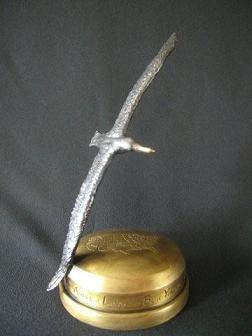
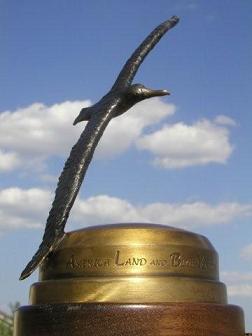



.jpg)
.jpg)
.jpg)
.jpg)
.jpg)
.jpg)

.jpg)
.jpg)
.jpg)
.jpg)
.jpg)
.JPG)
.jpg)
.jpg)

.jpg)
.JPG)